
Ipinapakita ang mga post na may etiketa na corman. Ipakita ang lahat ng mga post
Ipinapakita ang mga post na may etiketa na corman. Ipakita ang lahat ng mga post
Ene 2, 2021

Okt 4, 2019
Self-naming and the third line of Notley’s “Poem”
St. Mark’s Place caught at night in hot summer,
Lonely from the beginning of time until now.
Tompkins Square Park would be midnight green but only hot.
I look through the screens from my 3rd floor apartment
As if I could see something.
Or as if the bricks and concrete were enough themselves
To be seen and found beautiful.
And who will know the desolation of St. Mark’s Place
With Alice Notley’s name forgotten and
This night never having been?
Poets.org
Not as distant as Guadalajara nor as threatening as Vesuvius. Not noisy like the former nor certain like the latter.
As urgent as? As focused as?
The Ghazal-type signature pines, and I return a moment to Corman. Differences truly between Corman and Notley, but I can’t place these as surely as I can a distinction between two of my children forced to a morning goodbye.
Lonely from the beginning of time until now.
Tompkins Square Park would be midnight green but only hot.
I look through the screens from my 3rd floor apartment
As if I could see something.
Or as if the bricks and concrete were enough themselves
To be seen and found beautiful.
And who will know the desolation of St. Mark’s Place
With Alice Notley’s name forgotten and
This night never having been?
*
Poets.org
*
Not as distant as Guadalajara nor as threatening as Vesuvius. Not noisy like the former nor certain like the latter.
As urgent as? As focused as?
The Ghazal-type signature pines, and I return a moment to Corman. Differences truly between Corman and Notley, but I can’t place these as surely as I can a distinction between two of my children forced to a morning goodbye.
Okt 1, 2017
Notes on Cid Corman’s “Fire”
Is it the
principle
or process
of desire?
To take some
thing at all
once from it
self until
it pervades
emptiness—
warms and glows
and goes out.
But what is
out that is
not into?
—
It seems like someone has been staring at a candle, looking at how much (and how much nothing) goes into that hunger. Including his/her thoughts, desires, thoughts of desire, and desire to think—all of which should be eliminated if there’s to be any hope at all of extinguishing the ego, suffering.
—
The stanza cut yields us both. The sentence assigns pervades to it (it pervades emptiness, which seems to be something both occupying and being occupied by emptiness) but the cut allows emptiness its own stanza, where it may warm and glow, maybe as something quite distinct from just an emptied out some/thing.
—
Another, burdened with saying what’s nothing in such space.
—
principle
or process
of desire?
To take some
thing at all
once from it
self until
it pervades
emptiness—
warms and glows
and goes out.
But what is
out that is
not into?
*
—
It seems like someone has been staring at a candle, looking at how much (and how much nothing) goes into that hunger. Including his/her thoughts, desires, thoughts of desire, and desire to think—all of which should be eliminated if there’s to be any hope at all of extinguishing the ego, suffering.
—
The stanza cut yields us both. The sentence assigns pervades to it (it pervades emptiness, which seems to be something both occupying and being occupied by emptiness) but the cut allows emptiness its own stanza, where it may warm and glow, maybe as something quite distinct from just an emptied out some/thing.
—
Another, burdened with saying what’s nothing in such space.
—
Hun 10, 2016
Notes on Lima’s “Bright Blue Self-Portrait”
I thank the spiders’ webs and the circus dancers who stain our eyes with
Rapid movements and authorize our handcuffs to make no distinction
Between night and day or love and hate.
No one will know the sum of our arduous daily separations from bed to
Work. These pillars actually belong to you since I have not counted them
Or know any more than you do where they are or in what country they
Still exist. We can put all our concerns into a loaf of bread and French
Kisses, go to movies and watch the splashing milk on the screen imitate
The forest in the moonlight. Why all the fuss about the patrons becoming
Feathers, discharging their ideas of nobility on the evening news? There
Are no lights in the theater just soft snow from the balcony that is the
Little red schoolhouse where all this began.
Actually it was because of you I did not attend as often as I should have.
I was too embarrassed to face you across the clay modeling tables since I
Always felt like the clay in your hands was a cartoon version of my teen
Years, dear slippery-fish ladies of the sleepy west.
Don’t forget, my early life will be yours, too,
With its self-descriptions of poetic justice,
The tiny creatures we write about can describe themselves in the moss
We leave behind.
*
[ Poetry Foundation ]
*
—
—
D— Curious that the pillars are marked “these” and thus would have been close at hand, within view and maybe touch, but then the tail of the sentence denies knowledge of location. Maybe “these” because it’s in the mind, or on the table in a conversation. Or is it because they are still there somehow, his supports or foundations, but he also has no access or continued awareness of them?
—
D— Inability to cope would indeed explain the discontinuities. Maybe some of these pieces belong together though. Could the theater (or schoolhouse) be housing the pillars? But if so, why would “these” be uncountable? The darkness? And since it’s the theater, might that (slightly) account for the shifting country/ies?
—
D— And your word “faded”... could it be a set of photographs? That would multiply a single set of pillars. In which case, what is he handing over? The pillars, the pictures, or the memories (which could also be unreliable)?
—
D— Another take on the pillars. One of the theories about the origin of the $ sign is that it was derived from the Pillars of Hercules. That might account for “counted” and for the insane mobility of these pillars.
—
—
—
—
D— Also, the possibility that Lima might be addressing his child-self. But these lines—
Don’t forget, my early life will be yours, too,
With its self-descriptions of poetic justice,
These may point us to him in the act addressing his future self. Another thread-inspired possibility: he might be addressing his ideal self.
—
—
—
—
—
—
D— I thought this self-portrait had some parallels with Rilke’s (I pasted Lowell’s translation below). Blue is here too, inside the eyes, as if a portrait within a portrait. Perhaps Lima is figuring himself as that scared blue child? The “opening animal” here is a beast of burden, but in Lima we have the spider, and tiny creatures toward the end. In both there is a sense of being controlled by external (but internalized) forces (in Rilke, the figure of the mule, the idea of servitude, of speech kept in; in Lima the handcuffs and “No one will know the sum of our arduous daily separations from bed to / Work.”)
Self-Portrait
The bone-build of the eyebrows has a mule’s
or Pole’s noble and narrow steadfastness.
A scared blue child is peering through the eyes.
and there’s a kind of weakness, not a fool’s,
yet womanish––the gaze of one who serves.
The mouth is just a mouth . . . untidy curves,
quite unpersuasive, yet it says its yes,
when forced to act. The forehead cannot frown
and likes the shade of dumbly looking down.
A still life, nature morte––hardly a whole!—
It has done nothing worked through or alive,
in spite of pain, in spite of comforting . . .
Out of this distant and disordered thing
something in earnest labors to unroll.
—
—
—
—
—
—
—
—
—
D— There’s a theater, so maybe the “I thank” is like an acceptance speech (gone awry, berserk, or... interesting). Now if the “I thank” came from the schoolhouse, then maybe this a valedictory.
—
D— I thank the spiders’ webs and the circus dancers who stain our eyes with
And “stain” here would have been an easy substitute for “strain” and it did cause quite a strain whenever I come to read it, wondering if it’s a typo. Could there be others? If so, I’m thinking of “fathers” here:
Feathers, discharging their ideas of nobility on the evening news? There
—
—
D— Maybe there’s a hint of clay tablets in “clay modeling tables”? And if we’re entertaining Moses, other ancient expressions of law and order, then, those really are for modelling.
—
D— The West usually locate their exotica in the East. Edward Said built his discourse on Orientalism on that ground. The East is also known to have been characterized as “sleepy” say, “Sleeping Giant” as opposed to what might be a Western self-image of we have less resources, bitter weather, but we are untiring and industrious. There seems to be a reversal of these things here. The sirens, Odysseus, are at home, not far off in some uncharted land that have yet to taste your brand of clever.
Or, overreading in the morning. Have a nice day everyone.
—
—
—
—
D— Food is Lima’s specialty, so that’s perfect context for his majors and minors in the fourth stanza of “Felonies and Arias of the Heart”. Remembering Corman now, and marking this movement toward “you” that begins at the third stanza.
I very much like the last stanza, would like to hug it, make a pillow out of his pieces of paper, the candor of a poet saying yes, you know, I’m doing this to make an impression on you, I’m throwing in some flashy history too, dear reader, forever desirous of your love and attention, signed.
—
Hul 8, 2015
Eurydice
—
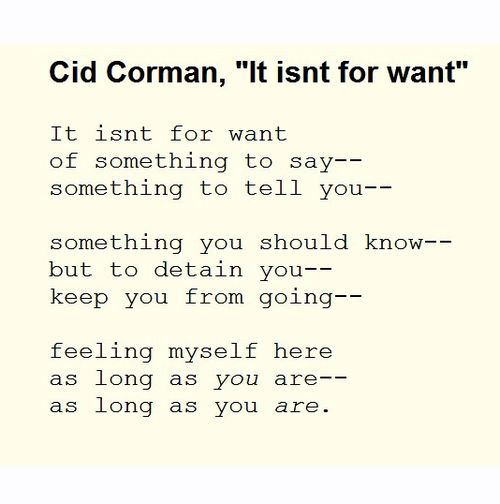
—glad that it works as both, and that if you want to take it as a love poem, you can take it as wholly that and so you have something and you are excused; you may go
—
—It's a bare no-nonsense-no-roses kind of declaration, maybe appeal. If you want a metapoem out of it, that's there too, for the taking (to keep you from going).
Detain is curious. A prison detains you, or the airport if a suspect or if missing papers (liminally, neither "in the country" nor out of it), other like (and yes negative, undesirable) situations. But at the same time it is the nature of desire, which becomes truly problematic when desiring a person. You want her/him in your keeping, unavailable to others, all faculties trained on you, your intents.
—
—control shifts
—
—The beloved is never detained, for one thing. And since the lover exists only within that span of such a tentative attention, she/he goes/departs/dissolves the moment the beloved goes.
Hun 11, 2015
Transmissions of Violence II
Enuresis
by Cid Corman
Terror—Ed—is not
Sitting in one's piss.
I know—I've sat there—
I've slept there and did
Most of my childhood.
That was warmth—in fact—
And comfort—in spite
Of the unconsealed
Unconsealable
Smell. Terror? That was
And always will be
Mother cursing Dad
And there there I am
Alone in that night
Hearing that door slam.
—
—
—
DE— The word “enuresis” works very well with the sounds of the first stanza. Also, it has an onomatopoeic quality.
—
—
DE— Thanks for this poem. Like him a lot as well. What I’ve heard of him, what I’ve read from his hands. I appreciate the poems where his layers are hidden, almost denied, like in his shorter haiku-type poems. The layers in this one’s more explicit, there are already (at least) two terrors, and they seem to increase the more you give to / take from the reading.
The first time I read it, I thought terror came from the punishment of the parents (door slam) but now it seems to me that we also behold the terror of the parents’ fight, the possibility of breaking up the family, abandonment. The pain blooms here, I think, as the poem confuses me (and maybe the child) if his enuresis was effect or cause of the parents heated argument, the door slamming not only between the child and his parents but also between the parents, and thus pressed, the child’s internal system finds a way, a small (unconsealable) way out.
—
—
—
—
—
—
AN— yes to all points! except maybe to that guilt part. So much time and possibility in the here and now for us and I’m glad to be here “as long as you are” with or without any buzz
—
—
—
—
—
DE— Bedwetting seems to move the focus away from what’s inside. The effect is emphasized. For me, “enuresis” works better to preserve that mystery, the struggle between child and adult, waking and dreaming, control and freedom.
—
—
DE—A bit more on the title. I find a sense of detachment in it. It’s an adult word, something he earned (or at least, looked up, looked into) and applied to the state of a younger self who would not have known the word at the time. Maybe an effort (futile?) to seal off or seal away the unconsealable.
by Cid Corman
Terror—Ed—is not
Sitting in one's piss.
I know—I've sat there—
I've slept there and did
Most of my childhood.
That was warmth—in fact—
And comfort—in spite
Of the unconsealed
Unconsealable
Smell. Terror? That was
And always will be
Mother cursing Dad
And there there I am
Alone in that night
Hearing that door slam.
*
—
—
DE— The word “enuresis” works very well with the sounds of the first stanza. Also, it has an onomatopoeic quality.
—
—
DE— Thanks for this poem. Like him a lot as well. What I’ve heard of him, what I’ve read from his hands. I appreciate the poems where his layers are hidden, almost denied, like in his shorter haiku-type poems. The layers in this one’s more explicit, there are already (at least) two terrors, and they seem to increase the more you give to / take from the reading.
The first time I read it, I thought terror came from the punishment of the parents (door slam) but now it seems to me that we also behold the terror of the parents’ fight, the possibility of breaking up the family, abandonment. The pain blooms here, I think, as the poem confuses me (and maybe the child) if his enuresis was effect or cause of the parents heated argument, the door slamming not only between the child and his parents but also between the parents, and thus pressed, the child’s internal system finds a way, a small (unconsealable) way out.
—
—
—
—
—
—
AN— yes to all points! except maybe to that guilt part. So much time and possibility in the here and now for us and I’m glad to be here “as long as you are” with or without any buzz
—
—
—
—
—
DE— Bedwetting seems to move the focus away from what’s inside. The effect is emphasized. For me, “enuresis” works better to preserve that mystery, the struggle between child and adult, waking and dreaming, control and freedom.
—
—
DE—A bit more on the title. I find a sense of detachment in it. It’s an adult word, something he earned (or at least, looked up, looked into) and applied to the state of a younger self who would not have known the word at the time. Maybe an effort (futile?) to seal off or seal away the unconsealable.
Dis 5, 2014
Done having alone inspected your things
They keep wanting a single slab for a stage and are entirely in the right to kid themselves. To say mother had been gardening, that her shoulders will shape an ache tonight between them, is also journalists under the grass blades of my Mindanao among which the breeze sings the afternoon. Every so often. To say I have read Agamemnon’s reviewer reviewed in translation twice in a sitting without ever having to find the courage to watch the (suggested) killing foreordains how I shall pour tea on your cornflakes by mistake. What manner of school am I paying for, what refuses to teach you gratitude in prayer form, the mere fact that we raised you in a house where corn enters in flake form, that the bowl admits no hair except yaya’s, now, say your goodbyes. Who “would live on into old age) had been ruptured,” a whip coming for me to pull an area of responsibility together. To know you is to be loved by you as to love you is to forget, gingerly, what else you need become. Fingers gnarled for this arroz caldo. The box-type won’t start, dad, only out of a hope that it, would, never, end. Insist on drawing my breath from the bubble of your throat.
Okt 1, 2014
Mga Alay
ni Cid Corman
aking salin
Napakaraming bagay sa altar.
Sasapat ang isang talulot.
O ang langgam na sandaling tumitigil dito.
aking salin
Napakaraming bagay sa altar.
Sasapat ang isang talulot.
O ang langgam na sandaling tumitigil dito.
Hun 23, 2013
Transmissions of violence
Enuresis
by Cid Corman
 Terror—Ed—is not
Sitting in one's piss.
I know—I've sat there—
I've slept there and did
Most of my childhood.
That was warmth—in fact—
And comfort—in spite
Of the unconsealed
Unconsealable
Smell. Terror? That was
And always will be
Mother cursing Dad
And there there I am
Alone in that night
Hearing that door slam.
—
—
—
AN— was oddly happy to hear about a poet who was very generous and responsive to the next generation. led me to think that maybe 'Mother' and 'Dad' here might also somehow represent previous generations of authorities (govt? literature?), i mean, other authorities too, yes, but also definitely (primarily?) the parents!
—
—
AN— cid is amazing. felt like i was right there with him between the sheets hearing the door slam
—
—
—
—
—
AN— graphic! but, okay
—
DE— Yes. And he was so aggressive about it, in the first two lines. He was so eager to negate his friend's experience of terror with his own recollection of it. Upon rereading it, I heard an echo of the door slamming in the first stanza. I see the persona "consealing" his friend by cutting out the claim he was responding to, by reburying "Ed" in the foxhole, between his dashes and the words "Terror" and ""is not". There's a third terror at play here.
—
DE— I subscribe to that reading, now that you mentioned it. I was looking for some other verbal play in the order of unconsealed and unconsealable in this poem, and thought there was none, until your idea came along. Also, I believe that if "Ed" was being actively absorbed by "Terror," then it supports (I hope) my idea that the Corman-persona here is likewise a source of a subtler (but for me, unmistakeable) form of violence.
AN— if only for this thread, i agree that enuresis would have been a fine addition to the syllabus. But for now, it remains our mean little secret
—
DE— Found your take on "in spite" and I see how that can be extended to Terror/Smell. It goes two ways after all, the situation in comparison being war. Eye for an eye. It makes me think too that while the "Ed" person has been somewhat coerced to take a position in the foxhole, this character (if taken as part of the US war machine) may be juxtaposed not only with the child but also with the parents.
—
—
—
—
—
—
DE— I'm sorry I didn't see you were asking a similar question I read earlier. If you scroll down a bit to her comments, I gave it a shot there. I said it's a portmanteau, a word coming from a combination of words. But it's not used beyond Corman (and us overnight Cormanites) so it's possibly a neologism or invented word.
—
—
—
—
DE— I think "unconsealed" is a portmanteau word. It's like smog which is a combination of two words, smoke and fog. Poets and fictionists (James Joyce is the great example of going crazy with this device) sometimes resort to this in order to enact various effects. Here, for me, it's a truly curious effect. He combines "concealed" with "sealed" and with the use of the prefix, he makes it to mean both unconcealed (revealed) as well as unseal (release). I love unconsealed though, as well as unconsealable, because as words forcing a union between themselves, it's as if they're still trying to conceal, still trying to seal. As if these words were the legs just won't come apart—even after all these years!—they're still trying to keep it in.
—
AN— unconsolable! that's a find! i'm glad they posted this thread, otherwise i'd totally miss that. Thanks for the riff
DE— Yes, thanks that you riffed on it. I was intrigued by the word since I first heard it, but now that you gave me that angle, it's now become my single my favorite word in the threads. And... I do hope you got something from the link. It was a good listen for me, and it gave me some insight not just for this poem but also for "It Isn't for Want"...
—
AN— I think this is a sound reading of the interplay of words. amazing how much nuance can be loaded into a poem
—
by Cid Corman
 Terror—Ed—is not
Sitting in one's piss.
I know—I've sat there—
I've slept there and did
Most of my childhood.
That was warmth—in fact—
And comfort—in spite
Of the unconsealed
Unconsealable
Smell. Terror? That was
And always will be
Mother cursing Dad
And there there I am
Alone in that night
Hearing that door slam.
—
—
—
AN— was oddly happy to hear about a poet who was very generous and responsive to the next generation. led me to think that maybe 'Mother' and 'Dad' here might also somehow represent previous generations of authorities (govt? literature?), i mean, other authorities too, yes, but also definitely (primarily?) the parents!
—
—
AN— cid is amazing. felt like i was right there with him between the sheets hearing the door slam
—
—
—
—
—
AN— graphic! but, okay
—
DE— Yes. And he was so aggressive about it, in the first two lines. He was so eager to negate his friend's experience of terror with his own recollection of it. Upon rereading it, I heard an echo of the door slamming in the first stanza. I see the persona "consealing" his friend by cutting out the claim he was responding to, by reburying "Ed" in the foxhole, between his dashes and the words "Terror" and ""is not". There's a third terror at play here.
—
DE— I subscribe to that reading, now that you mentioned it. I was looking for some other verbal play in the order of unconsealed and unconsealable in this poem, and thought there was none, until your idea came along. Also, I believe that if "Ed" was being actively absorbed by "Terror," then it supports (I hope) my idea that the Corman-persona here is likewise a source of a subtler (but for me, unmistakeable) form of violence.
AN— if only for this thread, i agree that enuresis would have been a fine addition to the syllabus. But for now, it remains our mean little secret
—
DE— Found your take on "in spite" and I see how that can be extended to Terror/Smell. It goes two ways after all, the situation in comparison being war. Eye for an eye. It makes me think too that while the "Ed" person has been somewhat coerced to take a position in the foxhole, this character (if taken as part of the US war machine) may be juxtaposed not only with the child but also with the parents.
—
—
—
—
—
—
DE— I'm sorry I didn't see you were asking a similar question I read earlier. If you scroll down a bit to her comments, I gave it a shot there. I said it's a portmanteau, a word coming from a combination of words. But it's not used beyond Corman (and us overnight Cormanites) so it's possibly a neologism or invented word.
—
—
—
—
DE— I think "unconsealed" is a portmanteau word. It's like smog which is a combination of two words, smoke and fog. Poets and fictionists (James Joyce is the great example of going crazy with this device) sometimes resort to this in order to enact various effects. Here, for me, it's a truly curious effect. He combines "concealed" with "sealed" and with the use of the prefix, he makes it to mean both unconcealed (revealed) as well as unseal (release). I love unconsealed though, as well as unconsealable, because as words forcing a union between themselves, it's as if they're still trying to conceal, still trying to seal. As if these words were the legs just won't come apart—even after all these years!—they're still trying to keep it in.
—
AN— unconsolable! that's a find! i'm glad they posted this thread, otherwise i'd totally miss that. Thanks for the riff
DE— Yes, thanks that you riffed on it. I was intrigued by the word since I first heard it, but now that you gave me that angle, it's now become my single my favorite word in the threads. And... I do hope you got something from the link. It was a good listen for me, and it gave me some insight not just for this poem but also for "It Isn't for Want"...
—
AN— I think this is a sound reading of the interplay of words. amazing how much nuance can be loaded into a poem
—
Hun 18, 2013
Or, Berrigan and the Whale
3 Pages
by Ted Berrigan
for Jack Collom

DE— Let me just say that my heart skipped a beat when Berrigan's list mentioned the Hunt for the Whale. I read Melville in my youth when no teacher required it of me, and it was one of my greatest reading experiences. In fact, when the line struck me, the whole poem was suddenly flooded by the novel's immense waters. Even the title reminded me of Ahab's own 3 "pages," Starbuck, Stubb, and Flask, petty officers and middlemen on this the grandest and most foolish of ventures.
AN— the first part of the novel is encyclopedic, a sort of melville's a dummies guide to whales, whaling, and the color white (that last part is my fave). formally, they're essays. if i remember right, there should be a good handful of lists in the pequod: what to do with blubber, what to do with whale parts (look up cassock!) and others, a lot of how-tos here and there. starbuck was the most practical of them, the least metaphysical, and he must be partial to these lists. of course ahab would dash them all and have it his way! he has his own list. and his methods of staking the ship to his own TO-DO, his theatrics, his mythic references, that sinister, inert doubloon!
—
—
AN— schopenhauer sounds right in this case. perhaps not only in our reading of the poem but also in berrigan's writing of it.
—
[A post was deleted]
DE— Ahab's mission, and this list of ten things to do. They're a whole universe apart in terms of grandeur and scope and yes time (and diction, as I think you're pointing out too). Though they're both America, that much is true. And maybe I'm forgetting (and you've reminded me) that the creation of this poem is itself the hunt for the whale.
—
AN— it could be a key to this, i agree. one among many, i'm sure bec of the nature of the poem, but still, a welcome entrance!
—
—
—
DE— The last lines after NO HELP WANTED doesn't seem like things you do every day. There's the heart attack, the medal of honor, the house in the country: these are things to aspire to, such that every day builds up to them. I guess in the back of the psyche there's something that gnaws, a less obvious, less acceptable desire, something more Quixotic (forgive the mixed references though I'm fairly certain Melville the sailor was likewise referencing Cervantes the sailor), therefore more grand than any desire. Still, there's that other thing. Ahab was all about revenge. Could this be the hidden motive (motif) of the poem? Berrigan's revenge on US conservatism (prosaic, sorry!), it's pretensions, how if it has any greatness in it, you'll find it solely in the shortcomings? For some deep yearning here is unanswered (WCW on the poem: for lack of which people die miserably every day). Which brings us back to the port of poem as whale as poem.
—
AN— and maybe beyond the revenge of the poem is the vindictive life. like Berrigan was saying something like: I won't get with your program folks! my poker, my lunch poems these fly in the face of your congressional medal of honor!
—
DE— Forgive the re-post here; I'd like the Mates in my ship as well. I tried to read Berrigan by using the 3 MATES of Ahab (as you suggested). There's something there, though not so clear-cut, but perhaps the others can make more of it.
Here it goes. Melville's Pequod is a ship of symbols (although it can be read as a driven narrative even without any eye for allegory, we thus have movies of it here and there) and as such is a very symmetrical construct. The 3 MATES can be read as the stages of the human brain: 1st mate STARBUCK is the voice of reason, the schooled one, a pragmatist at heart. 2nd mate STUBB is much less refined, but in moments of clarity he embodies a folk sort of wisdom. Nevertheless, he's more Gung-Ho and is thus more open to the seductions of Ahab. But 3rd mate Flask has practically sold his soul to Ahab even without him asking for it, and since it's clear we're moving down the brain here, Flask is more bile and vengeance; he really takes the whales personally.
Beer? Jack off? Curse? Probably Flask. hunker down, quite merrily, life goes by: We could probably get a whiff of Stubb's pipe here (though he seems to be smoking with Flask in the earlier parts too). Which means that the last, where happiness is not happiness but something negotiated with weather (sails?), that could be Starbuck there, the only dissenting voice when the ship went mad with Ahab's bloodlust. He's the one with his eye still on Mary, his wife, their "house in the country," their nameless son.
But all of their tempers and powers taken singly or together: NOT ENOUGH
—
DE— Others in the forum say that it's part of the incompleteness, the "NOT ENOUGH"
Poem says that it's a list of 10, but it doesn't always add up (though it depends on who's counting), almost always amounting to but nine items. In the anthology, it physically takes 2 pages, though it says three. So 3 pages follows that logic. (An aside, Calvino's "Six Memos" contains only five, suggesting we write the last one, perhaps that's the case here too? Add your page. Or add your thing-to-do?)
The others cut the poem into three, following the sectioning suggested by those phrases with purely capitalized letters. What do you think? Perhaps there's an important 3-page document somewhere in American history we should know about?
Anyway, I'm glad to have to think on it/ of it. Hope this helps.
—
DE— Hi! It's an idea I got from your 3 ages thread. I hope I didn't misquote you. But yes, put like that I see that it somehow not only "clusters" but "furthers" all the cutting that's already been done in/by the poem.
AN— a very good idea. the more you read it that way, the more the 3 "sets" or "pages" distinguish themselves from each other
—
DE— True and tragic, how the persona "can't even find that wholeness in the lifestyle of other Americans." He lists everything that everyone else is about but comes out empty-handed. Even with fame and security thrown in at the last breath.
AN— perhaps because fame and security was offered in the list? maybe that made it worse somehow?
—
DE— It's hard (for me) to put the whiteness of the whale out of the picture when inside North Am Lit, but because Berrigan does it in cuts he could evade full reference (as an epigram wouldn't, or a direct quote) and that sometimes makes for more richness, a more textured reading. Perhaps the "paging" I did with the mates was a stretch as well. But it was such fun doing it.
—
AN— the openness of a cropped line is interesting. that's probably why I loved not only following Tzara's instructions but reading the works of people who did. and now that Berrigan gives us a project like this, it's wonderful to welcome all associations in the tapestry of meaning
—
DE— Ishmael as the sailor behind (or grafted into) Berrigan's persona, that's promising. What a bummer to miss this, so: thanks! Ishmael's more laissez faire, a down and out man, going where the wind would take him. Melville must have been trying his damnedest to draw a blank of a character, someone who'd soak in the whole Pequod, all its men and methods then live to tell the tale. Ishmael is a survivor (the survivor) of the mad quest, and his presence could change the motif from revenge to just pure survival, openness, going at it one day at a time.
AN— she is on to something. Pip also is mad(dened) enough to deserve a second look as an intertext of this poem
—
AN— hegemonic parameters of quality? are you saying they are the gold standard of poets of the time? and that they are oppressive somehow as influence goes? if i hear from you, thanks
—
DE— I do love Berrigan too. He and Corman and Armantout, they're great "finds" for me, and only made possible by "This".
AN— perelman too now, and bernstein and hejinian
—
DE— I saw this a bit late, here's the summary of some hypotheses offered earlier:
1) NOT ENOUGH. 3 Pages makes you look for a page that isn't there (the poem takes up only two in a book), the texts and contexts from which these lines have been cut. It highlights the insufficiency of the list, perhaps also of listing, maybe of poetry.
2) 3 SECTIONS. Some believe that lines such as "BY THE WATERS OF MANHATTAN" cut the poem physically into three.
3) That the title refers to 3 PAGES known only to Berrigan (and other such "hidden" readings).
AN— or there are (at least) 3 ways of looking at everything here. maybe read/ lunch/ poems are three pages more than enough!
—
DE— Thanks!
by Ted Berrigan
for Jack Collom

DE— Let me just say that my heart skipped a beat when Berrigan's list mentioned the Hunt for the Whale. I read Melville in my youth when no teacher required it of me, and it was one of my greatest reading experiences. In fact, when the line struck me, the whole poem was suddenly flooded by the novel's immense waters. Even the title reminded me of Ahab's own 3 "pages," Starbuck, Stubb, and Flask, petty officers and middlemen on this the grandest and most foolish of ventures.
AN— the first part of the novel is encyclopedic, a sort of melville's a dummies guide to whales, whaling, and the color white (that last part is my fave). formally, they're essays. if i remember right, there should be a good handful of lists in the pequod: what to do with blubber, what to do with whale parts (look up cassock!) and others, a lot of how-tos here and there. starbuck was the most practical of them, the least metaphysical, and he must be partial to these lists. of course ahab would dash them all and have it his way! he has his own list. and his methods of staking the ship to his own TO-DO, his theatrics, his mythic references, that sinister, inert doubloon!
—
—
AN— schopenhauer sounds right in this case. perhaps not only in our reading of the poem but also in berrigan's writing of it.
—
[A post was deleted]
DE— Ahab's mission, and this list of ten things to do. They're a whole universe apart in terms of grandeur and scope and yes time (and diction, as I think you're pointing out too). Though they're both America, that much is true. And maybe I'm forgetting (and you've reminded me) that the creation of this poem is itself the hunt for the whale.
—
AN— it could be a key to this, i agree. one among many, i'm sure bec of the nature of the poem, but still, a welcome entrance!
—
—
—
DE— The last lines after NO HELP WANTED doesn't seem like things you do every day. There's the heart attack, the medal of honor, the house in the country: these are things to aspire to, such that every day builds up to them. I guess in the back of the psyche there's something that gnaws, a less obvious, less acceptable desire, something more Quixotic (forgive the mixed references though I'm fairly certain Melville the sailor was likewise referencing Cervantes the sailor), therefore more grand than any desire. Still, there's that other thing. Ahab was all about revenge. Could this be the hidden motive (motif) of the poem? Berrigan's revenge on US conservatism (prosaic, sorry!), it's pretensions, how if it has any greatness in it, you'll find it solely in the shortcomings? For some deep yearning here is unanswered (WCW on the poem: for lack of which people die miserably every day). Which brings us back to the port of poem as whale as poem.
—
AN— and maybe beyond the revenge of the poem is the vindictive life. like Berrigan was saying something like: I won't get with your program folks! my poker, my lunch poems these fly in the face of your congressional medal of honor!
—
DE— Forgive the re-post here; I'd like the Mates in my ship as well. I tried to read Berrigan by using the 3 MATES of Ahab (as you suggested). There's something there, though not so clear-cut, but perhaps the others can make more of it.
Here it goes. Melville's Pequod is a ship of symbols (although it can be read as a driven narrative even without any eye for allegory, we thus have movies of it here and there) and as such is a very symmetrical construct. The 3 MATES can be read as the stages of the human brain: 1st mate STARBUCK is the voice of reason, the schooled one, a pragmatist at heart. 2nd mate STUBB is much less refined, but in moments of clarity he embodies a folk sort of wisdom. Nevertheless, he's more Gung-Ho and is thus more open to the seductions of Ahab. But 3rd mate Flask has practically sold his soul to Ahab even without him asking for it, and since it's clear we're moving down the brain here, Flask is more bile and vengeance; he really takes the whales personally.
Beer? Jack off? Curse? Probably Flask. hunker down, quite merrily, life goes by: We could probably get a whiff of Stubb's pipe here (though he seems to be smoking with Flask in the earlier parts too). Which means that the last, where happiness is not happiness but something negotiated with weather (sails?), that could be Starbuck there, the only dissenting voice when the ship went mad with Ahab's bloodlust. He's the one with his eye still on Mary, his wife, their "house in the country," their nameless son.
But all of their tempers and powers taken singly or together: NOT ENOUGH
—
DE— Others in the forum say that it's part of the incompleteness, the "NOT ENOUGH"
Poem says that it's a list of 10, but it doesn't always add up (though it depends on who's counting), almost always amounting to but nine items. In the anthology, it physically takes 2 pages, though it says three. So 3 pages follows that logic. (An aside, Calvino's "Six Memos" contains only five, suggesting we write the last one, perhaps that's the case here too? Add your page. Or add your thing-to-do?)
The others cut the poem into three, following the sectioning suggested by those phrases with purely capitalized letters. What do you think? Perhaps there's an important 3-page document somewhere in American history we should know about?
Anyway, I'm glad to have to think on it/ of it. Hope this helps.
—
DE— Hi! It's an idea I got from your 3 ages thread. I hope I didn't misquote you. But yes, put like that I see that it somehow not only "clusters" but "furthers" all the cutting that's already been done in/by the poem.
AN— a very good idea. the more you read it that way, the more the 3 "sets" or "pages" distinguish themselves from each other
—
DE— True and tragic, how the persona "can't even find that wholeness in the lifestyle of other Americans." He lists everything that everyone else is about but comes out empty-handed. Even with fame and security thrown in at the last breath.
AN— perhaps because fame and security was offered in the list? maybe that made it worse somehow?
—
DE— It's hard (for me) to put the whiteness of the whale out of the picture when inside North Am Lit, but because Berrigan does it in cuts he could evade full reference (as an epigram wouldn't, or a direct quote) and that sometimes makes for more richness, a more textured reading. Perhaps the "paging" I did with the mates was a stretch as well. But it was such fun doing it.
—
AN— the openness of a cropped line is interesting. that's probably why I loved not only following Tzara's instructions but reading the works of people who did. and now that Berrigan gives us a project like this, it's wonderful to welcome all associations in the tapestry of meaning
—
DE— Ishmael as the sailor behind (or grafted into) Berrigan's persona, that's promising. What a bummer to miss this, so: thanks! Ishmael's more laissez faire, a down and out man, going where the wind would take him. Melville must have been trying his damnedest to draw a blank of a character, someone who'd soak in the whole Pequod, all its men and methods then live to tell the tale. Ishmael is a survivor (the survivor) of the mad quest, and his presence could change the motif from revenge to just pure survival, openness, going at it one day at a time.
AN— she is on to something. Pip also is mad(dened) enough to deserve a second look as an intertext of this poem
—
AN— hegemonic parameters of quality? are you saying they are the gold standard of poets of the time? and that they are oppressive somehow as influence goes? if i hear from you, thanks
—
DE— I do love Berrigan too. He and Corman and Armantout, they're great "finds" for me, and only made possible by "This".
AN— perelman too now, and bernstein and hejinian
—
DE— I saw this a bit late, here's the summary of some hypotheses offered earlier:
1) NOT ENOUGH. 3 Pages makes you look for a page that isn't there (the poem takes up only two in a book), the texts and contexts from which these lines have been cut. It highlights the insufficiency of the list, perhaps also of listing, maybe of poetry.
2) 3 SECTIONS. Some believe that lines such as "BY THE WATERS OF MANHATTAN" cut the poem physically into three.
3) That the title refers to 3 PAGES known only to Berrigan (and other such "hidden" readings).
AN— or there are (at least) 3 ways of looking at everything here. maybe read/ lunch/ poems are three pages more than enough!
—
DE— Thanks!
Mag-subscribe sa:
Mga Post (Atom)